
Great Britain runs 6.8 GW of batteries and has 427 GW waiting to connect
Live · the operating fleet, right now
Reading the fleet.
Reading the last 24 hours.
Reading the price.
Reading a week of prices.
The first three refresh every five minutes, the last one hourly. All four are measured rather than modelled. How they are worked out
Vitreous Labs reads NESO's connection registers twice a week alongside the capacity market, the planning database, Companies House and a full year of balancing mechanism settlement, and maps what is contracted, what is likely to fail and where capacity comes back.
Why a queue tool rather than a siting tool
NESO's connections reform allocated every megawatt of permitted battery capacity in all nineteen zones. 99.4% of the 83.2 GW Gate 2 book went to projects that were already protected, leaving 471 MW for everything else and nothing at all in the 2031 to 2035 phase. There is no open door to walk through.
So the useful question changes. Not where should a battery go, but which of the positions already in the queue will not be delivered, when that becomes visible, and at which substation the capacity returns. That is an attrition question, and it is answerable from published data if you read it carefully enough.
What is actually in it
| Layer | Records |
|---|---|
| Storage projects in the connection register | 1,563 |
| Connection points, 601 of them mapped | 937 |
| Capacity market battery sites with duration | 2,737 |
| Planning records from the renewable energy planning database | 2,668 |
| Transmission circuits and substations | 18,231 |
| Battery units registered in the balancing mechanism | 123 |
| Applicants resolved against Companies House | 1,530 |
Two tools
The queue tool maps what is contracted and what is likely to fail. The operating tool maps the batteries that already exist and what the balancing mechanism actually pays them, with live positions.
Every operating battery also has its own page, 217 of them, with what it earns, who owns it and who trades it.
Latest findings
No permitted battery capacity remains in any zone
NESO rations connections against the Clean Power 2030 targets. Queue formation allocated all of the battery allowance, and the published remaining figure is zero in all nineteen zones.
Read it →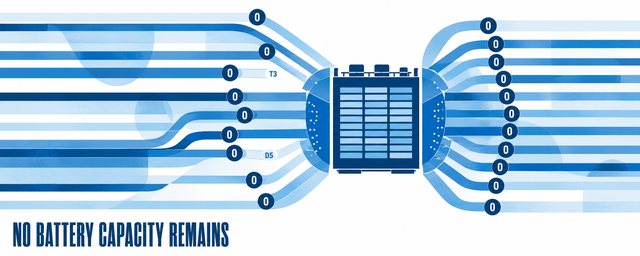
120 GW is queued at connection nodes that do not exist
122 strategic connection nodes created by the connections reform hold 120 GW of contracted storage between them, and not one megawatt of Gate 2.
Read it →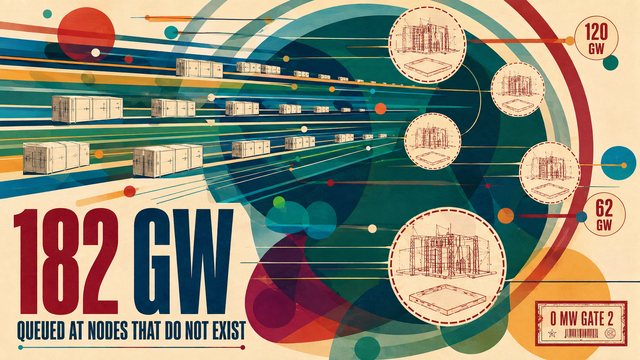
A battery in North Scotland is turned down 35 times as often as it is turned up
A full year of Elexon settlement data across the traded fleet shows a north to south gradient: the further north an asset sits, the more the system uses it as a sink and the less it earns. Two small English zones interrupt it.
Read it →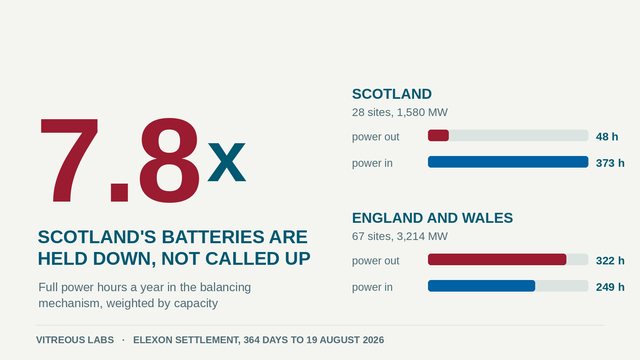


How it is kept honest
Every number traces to a published file or is labelled as inference. Where a coordinate is inferred rather than published, the mark on the map is drawn differently and the popup says how it was derived. Where the published data is ambiguous, the tool says so instead of picking a reading. Data that is absent is never invented.
How every number is worked out · What you may do with each layer